



Building formal psychological theories with intuitive computational tools - Training session
Training session with Alain Finkel, Raphael Faure, Gaspard Fougea, and Stéphane Le Roux, that will take place at ENS Paris-Saclay. Registration is free but mandatory. Click here to register.
Dates
- In person
- June 12th 2026, 10:30am - 4pm
- Online (Zoom)
- June 16th 2026, 10:30am - 4pm
Abstract
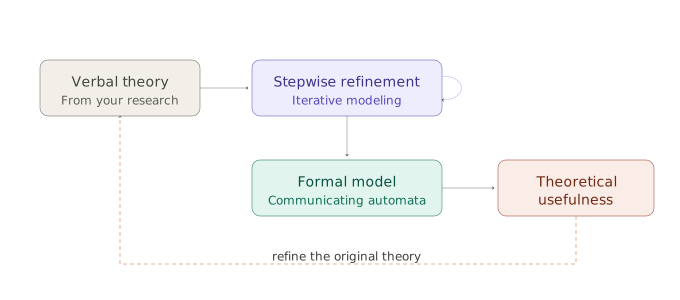
The replicability crisis stems partly from a lack of formal models in psychology. In many scientific disciplines, formal modeling plays a crucial role in theory-building: it enhances the precision of predictions, strengthens scientific reasoning, and facilitates collaboration. In this workshop, we introduce a computational framework and methodology for stepwise translating verbal psychological theories into formal models, as well as for verifying the faithfulness of these models to the original theories. This approach leverages tools from theoretical computer science to support theory development, modular design, formal verification, and comparative analysis.
This framework is designed to be both fully formal, with precise mathematical definitions and properties, and easy to grasp through intuitive visual representations. Applying it to a verbal theory highlights theoretical ambiguities and inconsistencies, and prompts research questions.
The workshop is designed as a hands-on introduction to this framework. Participants will be invited to bring a verbal theory from their own research and will be guided in translating it into a formal model. We will teach participants how to extract concepts and developments from the verbal theory and how to use refinement operations to model them.
We propose a four-hour format in which we will: explain the framework and methodology by providing an example; apply it to a new theory collectively; help participants apply it individually in groups of two or three with our support; and then help them identify new research questions that emerged from the modeling.
Video teasers
Three short videos to familiarize yourself with the framework before the session:
- Introduction to the framework (1 min 20)
- An overview of the tools we use (7 min 20)
- A short example of modeling (5 min)
This framework is also useful for the modeling of neuro-cognitive theories.
Program
- 10h30 - 11h15: Introduction to communicating finite automata. A short example of modeling.
- 11h15 - 11h45: One participant explains his theory to the group, and the whole group tries to use the methodology
- 11h45 - 12h00: The organizers suggest one way of modeling the theory
- 12h00 - 12h30: Explanation on refinement and how to use it to model this specific theory
- 12h30 – 14h00: Lunch Break (participants are invited for the in-person event)
- 14h00 - 15h30: Participants are in groups of two or three, and they share their theories and focus together on modeling successively their theories. They note theoretical ambiguities and inconsistencies, as well as research questions identified by the modeling. We offer support.
- 15h30 - 16h00: Final discussion on the difficulties encountered and how to improve the modeling process.
Who is this for?
No prior knowledge of formal methods or computer science is required. The framework is designed to be grasped through visual representations.
Psychologists
Neuroscientists
Cognitive scientists
Mathematicians or computer scientists
Any researcher interested in cognitive modelling
Practical information
How to reach ENS Paris-Saclay: Directions
Transit apps (real-time): Citymapper, Transit, RATP
We will meet at the entrance hall at 10:15.